
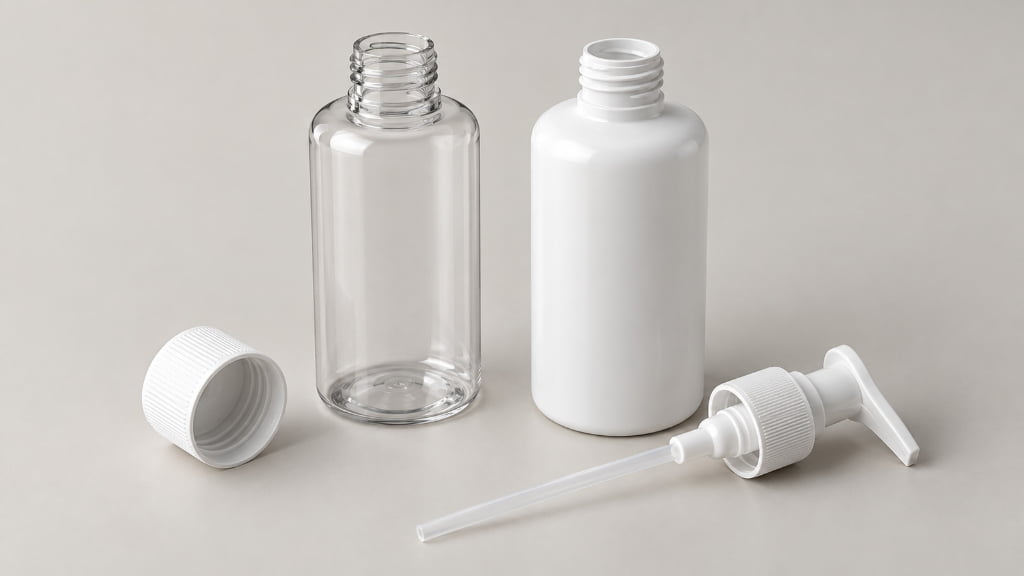
A bottle neck finish is the shape and dimensions of the bottle opening where a cap, pump or sprayer attaches. These parts are also called closures. When choosing a replacement, start with the full finish code, such as 24/410, then compare the bottle and closure drawings and evaluate samples together.
Use this bottle neck finish chart to read selected plastic-bottle sizes and prepare a request for cosmetic packaging samples. Tell the supplier whether you are keeping an existing bottle or choosing a new one.
Bottle Neck Finish Chart at a Glance
The chart compares five sizes from the SP400 and SP410 plastic-bottle drawings. T measures across the outside of the threads. H is the finish height, measured from the reference points explained in the diagram below.
Selected plastic-bottle SP reference dimensions — all dimensions in millimeters
| Finish code | Nominal size | T: thread diameter | H: finish height | Reference drawing |
|---|---|---|---|---|
| 18/410 | 18 | 17.68 ±0.20 | 13.28 ±0.38 | SP410 |
| 20/410 | 20 | 19.69 ±0.20 | 14.07 ±0.38 | SP410 |
| 24/410 | 24 | 23.67 ±0.20 | 16.41 ±0.38 | SP410 |
| 28/410 | 28 | 27.38 ±0.25 | 17.98 ±0.38 | SP410 |
| 24/400 | 24 | 23.67 ±0.20 | 10.16 ±0.38 | SP400 |
Sources: SP410 reference drawing and SP400 reference drawing, hosted by ISBT (revised March 10, 1999). These are plastic-bottle reference dimensions; confirm actual fit using supplier drawings and sample testing.
The ± values are tolerances: the permitted variation above or below each stated dimension in these drawings. For T and E, the drawings use the average of two measurements taken 90° apart.
Notice that the nominal 24 size has a reference T diameter of 23.67 mm, not exactly 24 mm. “Nominal” means the size designation; use the actual drawing when comparing dimensions.
How to Read a Bottle Neck Finish Code
What the Two Parts of the Code Tell You
In 24/410, “24” identifies the nominal diameter series and “410” identifies the finish series. Read the two numbers together when comparing bottle neck finish sizes. The second number is not a height in millimeters.
A request for “a pump for our 24/410 bottle” is more specific than “a 24 mm pump.” Attach the bottle drawing so the supplier can see the thread shape, dimensions and tolerances behind that code.
Keep the full code on quotations and sample requests. If a supplier offers a different finish, have them explain the difference before you compare prices.
Comparing 24/400 and 24/410
The two reference drawings show why diameter alone is not enough. Both 24/400 and 24/410 have T = 23.67 mm, but their H values differ: 10.16 mm for 24/400 and 16.41 mm for 24/410.
If you are keeping a 24/410 bottle, do not order a 24/400 cap or pump simply because both are described as 24 mm. Start with the requested finish, then compare the complete bottle and closure specifications.
Bottle Neck Finish Dimensions: Reading the Drawing
Look for T, E, I, H and S when reading bottle neck finish dimensions. These letters identify different measurement locations. The explanations below follow the SP drawings above and ISBT’s finish-dimension nomenclature.
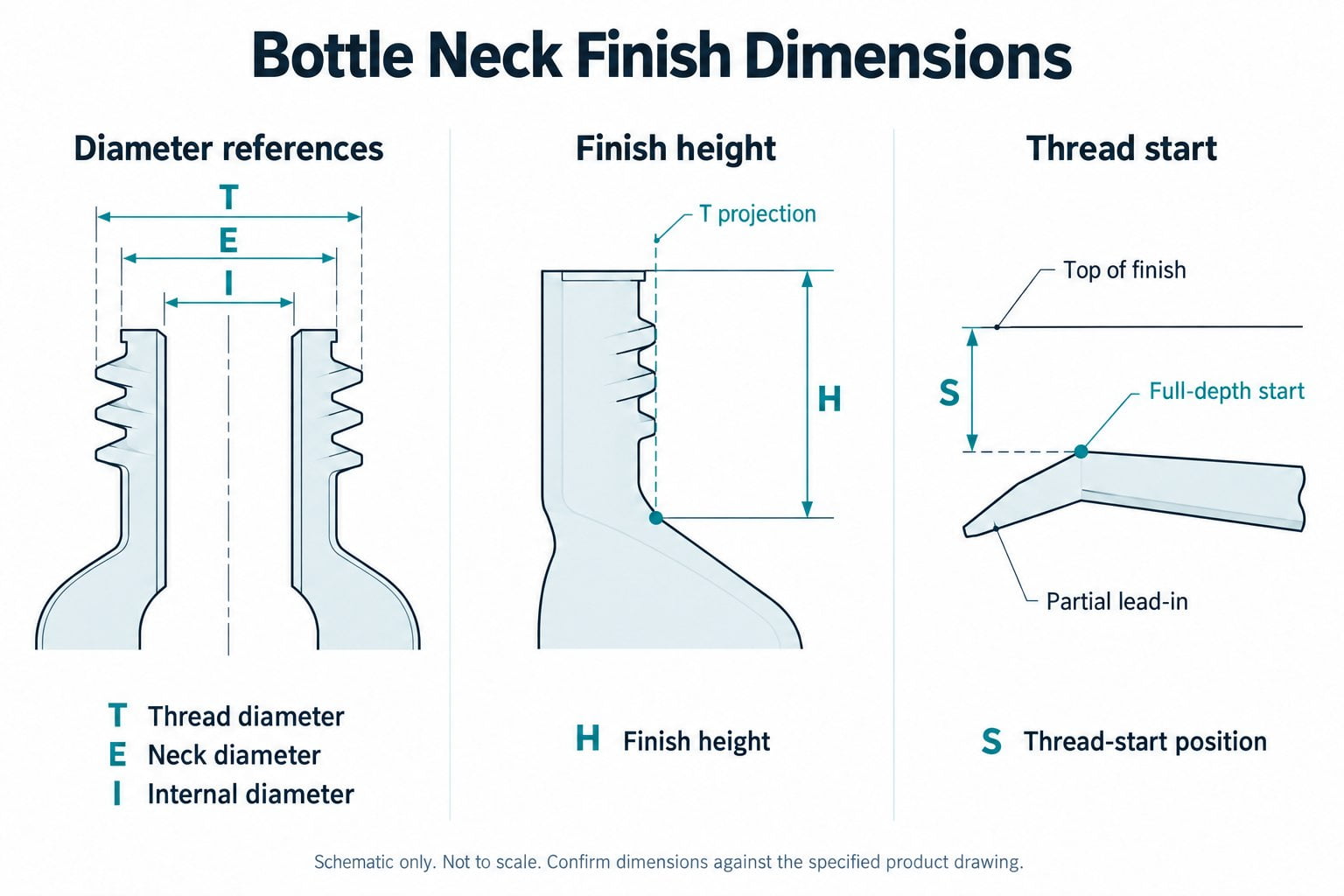
Original explanatory diagram. The three views show measurement locations, not a complete bottle design. Not to scale; use your product drawing for actual measurements.
Locate T, E and I
T and E describe the outside of the neck; I describes the opening inside it.
| Dimension | What it measures | How to use it |
|---|---|---|
| T | Diameter across the thread crests, the outermost raised edges | Use it to compare the outside thread size shown on the bottle drawing. |
| E | Diameter across the thread roots, the neck surface beneath the raised threads | Include it in the comparison; T alone does not describe the neck profile. |
| I | Minimum internal diameter through the finish | Check the opening available for filling equipment or a part inserted into the bottle. |
Measuring across the hole gives an internal diameter, not T. Label any measurements you send so the supplier knows which dimension you mean. If a plug or another part fits inside the opening, include its drawing as well; I alone does not confirm that the part will fit.
Locate H and S
H and S both start at the top of the finish, but end at different points:
- H — finish height. In the SP400/SP410 drawings, extend the T diameter downward, parallel to the bottle's centerline, until it meets the shoulder. H runs from the top of the finish to that intersection. The diagram marks this lower point.
- S — thread-start position. Measure from the top of the finish to where the thread reaches its full depth, beyond the partial thread at its beginning. S is not the spacing between thread turns.
For a replacement closure, include both dimensions when reviewing the bottle drawing. H helps describe the finish height; S locates the thread start. Neither should be estimated from overall bottle height or a photograph.
If two drawings show different values, check that they use the same reference points before comparing the numbers.
Matching Cosmetic Bottles With Caps, Pumps and Sprayers
A finish code helps narrow the search. The next step is to compare how the proposed cap or pump attaches and seals, then try the complete bottle and closure together.
Screw Caps and Sealing Components
When comparing cosmetic bottle caps and closures, find out how each cap seals. It may use a liner, a sealing insert inside the cap, an inner plug or another sealing feature.
The SP drawings call for checking the bottle's top-surface width against the sealing system. Include the proposed liner or plug in the sample request so you can assess the complete connection. A cap's color and finish code do not tell you how it seals.
Pumps and Sprayers
For cosmetic pumps and sprayers, describe both the bottle connection and how you want the product dispensed. Specify the pump or sprayer model, any locking requirement and the desired output, meaning the amount dispensed per use.
Where the design uses a dip tube, the tube extending into the bottle, provide the bottle's overall height and drawing. Overall height is different from neck-finish height H; the supplier needs the bottle details to specify the tube.
Use the following checklist when comparing components:
| Component | What to check with the supplier | Information to provide |
|---|---|---|
| Screw cap | Full finish code, cap dimensions and how it seals | Bottle drawing and proposed cap specification |
| Liner or plug | Where it contacts the bottle and which part will be supplied | Part specification and intended product/use conditions |
| Pump or sprayer | Bottle connection, seal, dip tube where used, and output | Bottle/component drawings and dispensing requirements |
If you are also choosing the bottle material, our guide to PET vs HDPE cosmetic bottles covers appearance, dispensing and sample selection.
Keeping an Existing Bottle and Changing the Pump
Consider this hypothetical example: you want a new locking pump for an existing 24/410 lotion bottle. You plan to keep the bottle unchanged and receive three offers:
| Hypothetical offer | What you know | Next decision |
|---|---|---|
| Pump A: 24/400 | The finish code differs from your bottle's code | Request the specified finish or an explanation of the proposed change before proceeding. |
| Pump B: 24/410, drawing supplied | The code matches and the dimensions are available | Compare it with your bottle drawing, then arrange samples if the proposed combination is suitable. |
| Pump C: 24/410, photograph only | The code matches, but dimensions are missing | Request the pump drawing before comparing it with Pump B. |
Pump B gives you more information to work with, but the drawing is only part of the decision. Evaluate the proposed pump on your bottle with the intended product before approving the replacement. A matching code does not show how the complete package seals or dispenses.
Your inquiry could say: “We are keeping our existing 24/410 lotion bottle and need a locking pump. The bottle drawing is attached. Please send the proposed pump drawing, details of the seal and dip tube, and the sample checks you recommend for this combination.”
How Fomalhaut checks samples
At Fomalhaut, sample checks can include dimensions, sealing and dispensing output, depending on the product and project.
Dispensing-output checks assess how much product comes out. Before sending samples, agree which checks apply, who will supply the product for testing and what the complete bottle and pump need to meet.
What to Send Before Requesting Matching Samples
Start with the bottle you have, the closure you need and anything that must stay unchanged. You can copy and fill in this template:
Product and use conditions: Product type; relevant filling, storage and use conditions.
Bottle: Capacity, overall height, finish code; drawing and revision number, or available sample.
Closure needed: Cap, pump or sprayer; preferred model, locking feature and output where relevant.
What must stay unchanged: Bottle, closure appearance or other existing parts; where alternatives are acceptable.
Sample requirements: Sealing and dispensing requirements; who will evaluate the complete bottle and closure.
Project details: Planned quantity, target market and timing.
Attach current drawings if you have them. Otherwise, send clear photographs of the opening, threads and existing closure, and say whether a physical sample is available. Mark anything you do not know as “unknown”; you do not need every dimension to start the conversation.
Frequently Asked Questions
What does 28/410 mean on a bottle?
It identifies a nominal 28 mm diameter series and a 410 finish series. The 28 is a size designation, not an exact measurement of every diameter. In the cited SP410 drawing, the outside thread diameter T is 27.38 ±0.25 mm.
Are 24/400 and 24/410 interchangeable?
Do not assume they are interchangeable. In the cited plastic-bottle drawings, both have T = 23.67 ±0.20 mm, but H is 10.16 mm for 24/400 and 16.41 mm for 24/410. Select a closure using the full bottle and closure specifications, then check assembled samples.
How can I identify a bottle neck finish without a drawing?
Look for the original supplier's product reference or a code on the existing cap or pump. If neither is available, share photographs and a physical sample with the supplier. Photos can help narrow the search, but they cannot establish every finish dimension.
Can a glass bottle and a plastic bottle use the same closure?
Possibly, if the closure suits the actual finish and sealing details of both bottles. Compare their drawings and evaluate the closure on each bottle. The plastic-bottle dimensions in this article do not establish a fit with a glass bottle.
Fomalhaut supplies cosmetic packaging options, with specific bottle and component combinations subject to project confirmation. Share your bottle drawing or sample details and tell us which cap, pump or sprayer you need. We can then discuss suitable options and the next steps for samples.
Send Your Bottle and Closure Specifications
<!--[googlesitekit-end-of-content]-->